---
title: "Refreshing the blog — again"
date: 2026-04-15
slug: refreshing-the-blog
authors:
- lunik
description: How and why I migrated my personal website from MkDocs + raw HTML to a Docusaurus + Vite monorepo
related_posts:
- init
tags:
- blog
- website
- docusaurus
- vite
- npm
- nodejs
- monorepo
- gitlab-ci
- devops
- sysops
- it
---
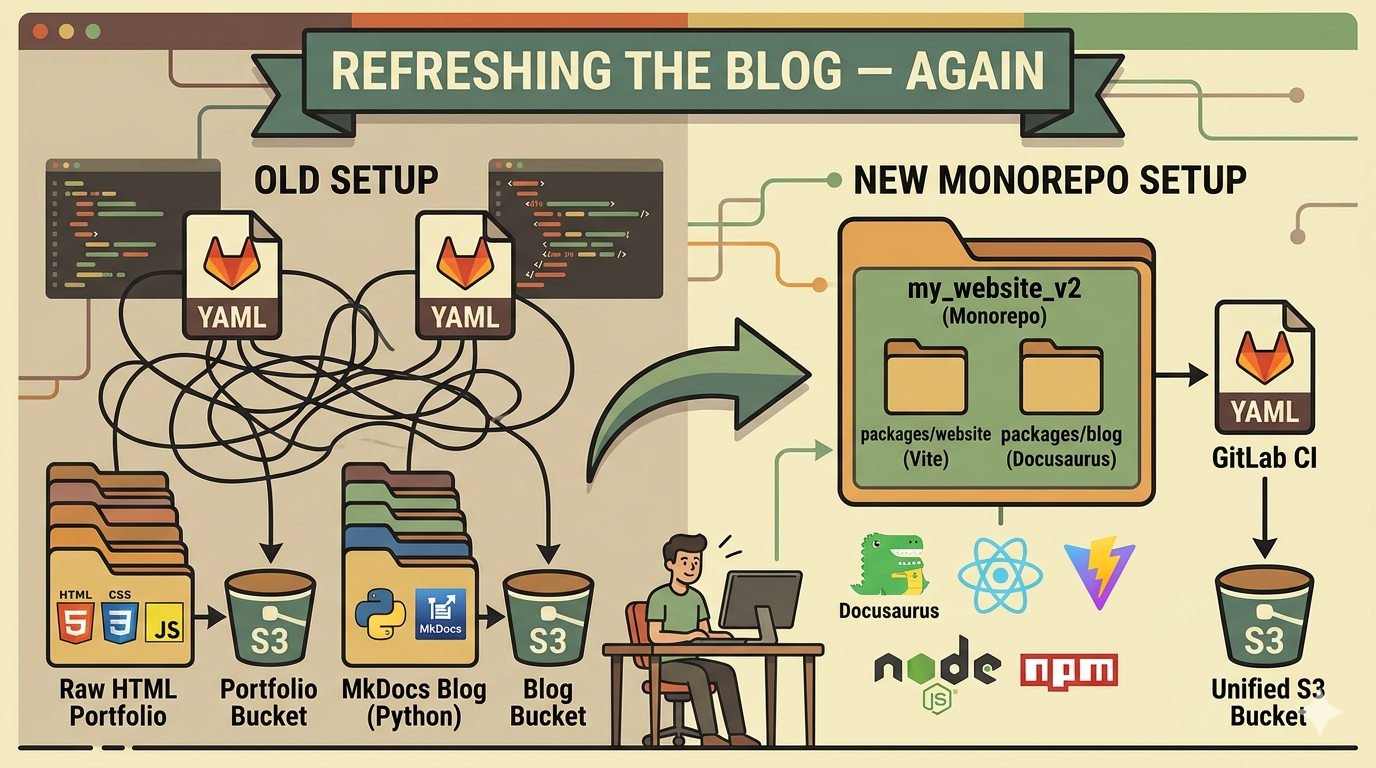
A while ago I wrote [a blog post about how I created this blog][init-post]. Back then it was [Pelican][pelican-website], a [Python][python-website] static site generator. Then I migrated it to [MkDocs][mkdocs-website] — also [Python][python-website], a bit more modern, better support for my bilingual setup. Now here we are again. Third time.
This is the story of why I did it and how it went.
:::info
If you are reading this on the blog, it means the migration is done. Congratulations, you survived the downtime.
:::
## The old setup
Let me describe what I had before so you understand why I wanted to change it.
### The portfolio
A raw [HTML][html-website]/[CSS][css-website]/[JavaScript][javascript-website] website. No build step. No bundler. Just files on a disk that I uploaded to [S3][aws-s3-website].
It worked. But it was painful to maintain. All the [CSS][css-website] was in one 600-line file mixing colors, layout and components. There was no clear separation between data and presentation. The [JavaScript][javascript-website] was procedural, with `eval()` calls to map string property names to DOM attributes. Dependencies were pulled from CDNs with hardcoded version numbers in `
```
Now it's a proper [npm][npm-website] dependency imported as an ES module:
```javascript
import { UAParser } from 'ua-parser-js'
```
## Migrating the blog content
### The migration script
I wrote a one-shot [Node.js][nodejs-website] script to migrate all the [MkDocs][mkdocs-website] posts to [Docusaurus][docusaurus-website] format. The main things it had to handle:
**Frontmatter**: [MkDocs][mkdocs-website] Material uses `categories` and `tags` as separate fields, [Docusaurus][docusaurus-website] only has `tags`. The script merges them and deduplicates. It also removes the `readtime` field since [Docusaurus][docusaurus-website] computes reading time automatically.
**Admonitions**: [MkDocs][mkdocs-website] uses `!!! warning "Title"` syntax, [Docusaurus][docusaurus-website] uses `:::warning[Title]`. A regex handles the conversion:
```javascript
content = content.replace(
/^!!!\s+(\w+)(?:\s+"([^"]*)")?\n\n?((?:(?: |\t)[^\n]*\n?)+)/gm,
(_, type, title, body) => {
const dedented = body.replace(/^( |\t)/gm, '')
const header = title ? `:::${type}[${title}]` : `:::${type}`
return `${header}\n${dedented.trim()}\n:::\n`
}
)
```
**Directory structure**: [MkDocs][mkdocs-website] posts are in `docs/en/posts/slug/index.md` with no date in the path. [Docusaurus][docusaurus-website] wants `blog/YYYY-MM-DD-slug/index.md`. The script reads the `date:` field from frontmatter and prefixes the directory name.
**Truncation markers**: [MkDocs][mkdocs-website] uses `` for the post excerpt cutoff. [Docusaurus][docusaurus-website] uses ``. A simple find and replace.
### Bilingual content
The EN posts go in `packages/blog/blog/`. The FR posts go in `packages/blog/i18n/fr/docusaurus-plugin-content-blog/`. Images are stored with the EN post and FR posts reference them with the same relative path — [Docusaurus][docusaurus-website] resolves them correctly at build time.
## The fun problems
### Node 25 and the localStorage error
The [Docusaurus][docusaurus-website] SSG build crashed on [Node.js][nodejs-website] 25 with:
```
Cannot initialize local storage without a --localstorage-file path.
```
[Node.js][nodejs-website] 25 ships the [Web Storage API][webstorage-mdn] natively, but unlike browsers, it requires an explicit file path to persist data. [Docusaurus][docusaurus-website] uses `localStorage` internally during SSG for theme persistence and had no idea this API now needed initialization.
The fix is a [Node.js][nodejs-website] CLI flag:
```shell
NODE_OPTIONS='--localstorage-file=/tmp/docusaurus-ls' docusaurus build
```
It's in the `package.json` build script and in the [GitLab CI][gitlab-ci-website] `variables` block.
### Non-breaking spaces
HTML collapses consecutive regular spaces into one. Everyone knows that. Fewer people remember it when writing strings that will be injected as `innerHTML`.
The terminal homepage has two commands whose output relies on column alignment: `locate` (links padded to a common width before the `#` comment) and `ls -l /bin` (file sizes and dates right-aligned). The original source used U+00A0 non-breaking spaces for that padding, not regular spaces. In HTML, ` ` or its Unicode equivalent is the only whitespace character that does not collapse.
During the migration, every text editor, diff tool, and copy-paste involved in moving those strings treated U+00A0 as an ordinary space. They all came out as U+0020. The columns disappeared silently — no build error, no test failure, just a cosmetic regression that you only notice when you look at the page.
The fix is surgical: find the original source, extract the raw bytes, restore them. A one-liner in Python to grep the original file and count `\xa0` occurrences confirmed it, then a direct byte-level substitution put them back.
Lesson: if column alignment in HTML matters, use a `` or `white-space: pre` and keep the string in a separate file where a linter cannot touch it.
### webpack 5.106 and webpackbar
[Docusaurus][docusaurus-website] 3 uses [webpack][webpack-website] 5 internally. [webpackbar][webpackbar-website] — the progress bar plugin — was updated to 6.0.1, which passed options (`name`, `color`, `reporters`) to [webpack][webpack-website]'s `ProgressPlugin`. But [webpack][webpack-website] 5.100+ removed those options from `ProgressPlugin`.
The result: the blog build crashed at startup with an obscure plugin options error.
The fix was to pin [webpack][webpack-website] to `5.95.0` as a direct `devDependency` in `packages/blog/package.json`. npm workspace resolution picks it up and uses it instead of resolving the latest 5.x version.
```json
{
"devDependencies": {
"webpack": "5.95.0"
}
}
```
Not great, but it works until [Docusaurus][docusaurus-website] ships a fix upstream.
## The CI pipeline
The new `.gitlab-ci.yml` is three stages: `install`, `build`, `deploy`.
```
install → build → pages (develop branch)
→ publish (master branch)
```
The `pages` job copies `dist/` to `public/` for [GitLab Pages][gitlab-pages-website] on the `develop` branch. The `publish` job runs `rclone sync` to push `dist/` to S3 on the `master` branch.
Before this, I had two pipelines with two separate S3 deploy jobs, one of which used an exclusion pattern to avoid overwriting the blog that was deployed from the other pipeline. Now it's a single `rclone sync` with no exclusions:
```shell
rclone sync --checksum --delete-during --quiet \
--s3-provider AWS \
--s3-access-key-id "$AWS_ACCESS_KEY_ID" \
--s3-secret-access-key "$AWS_SECRET_ACCESS_KEY" \
--s3-region eu-west-3 \
./dist :s3:website-lunik.tiwabbit.fr
```
`--delete-during` removes files from the bucket that no longer exist in `dist/` as the sync runs. `--checksum` uses checksums rather than modification times to detect changes — more reliable for files that get reassembled from the same source. Clean.
## Conclusion
Three iterations of this blog. [Pelican][pelican-website], then [MkDocs][mkdocs-website], now [Docusaurus][docusaurus-website]. Each time the tooling gets better and the maintenance overhead gets lower.
The monorepo was the right call. Having the portfolio and the blog in the same repository, with the same build pipeline, is genuinely less annoying than maintaining two separate projects. I should have done it earlier.
The source is at [gitlab.com/Lunik/my_website_v2][repo-gitlab].
[init-post]: /blog/init
[pelican-website]: https://getpelican.com
[mkdocs-website]: https://www.mkdocs.org
[mkdocs-material-website]: https://squidfunk.github.io/mkdocs-material/plugins/blog/
[docusaurus-website]: https://docusaurus.io
[vite-website]: https://vitejs.dev
[react-website]: https://react.dev
[meta-website]: https://opensource.fb.com
[astro-website]: https://astro.build
[11ty-website]: https://www.11ty.dev
[nodejs-website]: https://nodejs.org
[npm-website]: https://www.npmjs.com
[npm-workspaces-docs]: https://docs.npmjs.com/cli/using-npm/workspaces
[python-website]: https://www.python.org
[html-website]: https://developer.mozilla.org/en-US/docs/Web/HTML
[css-website]: https://developer.mozilla.org/en-US/docs/Web/CSS
[javascript-website]: https://developer.mozilla.org/en-US/docs/Web/JavaScript
[esmodules-mdn]: https://developer.mozilla.org/en-US/docs/Web/JavaScript/Guide/Modules
[css-custom-properties-mdn]: https://developer.mozilla.org/en-US/docs/Web/CSS/Using_CSS_custom_properties
[webstorage-mdn]: https://developer.mozilla.org/en-US/docs/Web/API/Web_Storage_API
[ua-parser-website]: https://github.com/faisalman/ua-parser-js
[gruvbox-website]: https://github.com/morhetz/gruvbox
[webpack-website]: https://webpack.js.org
[webpackbar-website]: https://github.com/unjs/webpackbar
[aws-s3-website]: https://aws.amazon.com/s3/
[gitlab-ci-website]: https://docs.gitlab.com/ee/ci/
[gitlab-pages-website]: https://docs.gitlab.com/ee/user/project/pages/
[repo-gitlab]: https://gitlab.com/Lunik/my_website_v2